Upgrading Central Heating Controls for Efficiency: A 2026 London Guide
Why spend thousands on a new boiler when the real "brain" of your home's heating is likely stuck in the 1990s? If you're battling high monthly energy bills and freezing cold spots in your London terrace, you know that manual programmers are frustrating. You want a home that stays warm without wasting money on empty rooms. Upgrading central heating controls for efficiency is the fastest way to gain absolute authority over your comfort and your costs.
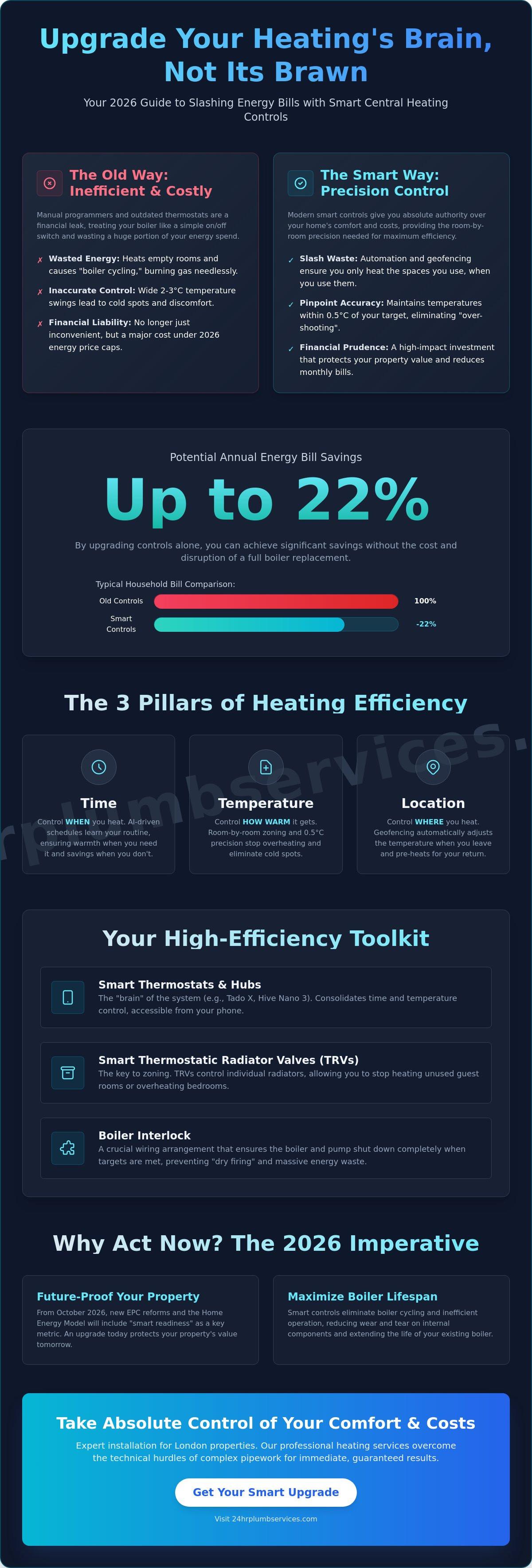
You can slash your energy bills by up to 22% without the disruption of a full boiler replacement. This 2026 guide reveals how modern smart thermostats and multi-zone valves provide the room-by-room temperature control you need. You'll discover the latest technology like the Tado X series and Hive Nano 3 Hub. We'll also explain how these upgrades help you stay ahead of the October 2026 EPC reforms and the new Home Energy Model. It's time to take control, stop the waste, and secure long-term financial prudence for your household.
Key Takeaways
Stop treating your boiler like a simple on-off switch. Learn why manual programmers are a financial liability under 2026 energy price caps.
Master the three pillars of heating efficiency. Discover how combining time, temperature, and location controls eliminates cold spots in older London properties.
Start upgrading central heating controls for efficiency to gain room-by-room precision. Smart Thermostatic Radiator Valves (TRVs) allow you to heat only the spaces you actually use.
Leverage automation to slash waste. See how AI-driven schedules and geofencing ensure you never pay to heat an empty London flat again.
Ensure a seamless transition with professional heating services. Expert installation overcomes the technical hurdles of complex London pipework for immediate results.
Table of Contents
Why Upgrading Central Heating Controls is the Smartest Efficiency Move in 2026
The Essential Components of a High-Efficiency Control System
Smart Heating Controls: Comparing the Best Options for London Homes
The 24hr Plumbing Advantage: Expert Control Upgrades in London
Why Upgrading Central Heating Controls is the Smartest Efficiency Move in 2026
Your boiler is the muscle of your home, but the controls are the brain. If the brain is slow or inaccurate, the muscle wastes energy. Upgrading central heating controls for efficiency is the single most effective way to stop this waste. In 2026, with the Ofgem energy price cap at £1,641 for typical households, every degree of heat matters. Manual controls are no longer just inconvenient. They are a financial leak in your home. You don't always need a new boiler to see a drop in your bills. You need better instructions for the one you already have.
Many Londoners assume they need a full boiler replacement to achieve modern efficiency. That is often an expensive mistake. A high-spec condensing boiler paired with ancient controls is like driving a supercar with a broken GPS. You'll get where you're going, but you'll burn far more fuel than necessary. Precision is the goal. Modern digital systems maintain temperatures within 0.5°C of your target. This prevents "over-shooting," a common problem where radiators keep pumping heat long after the room is comfortable. This small change stops your gas meter from spinning unnecessarily.
The Hidden Cost of Outdated Mechanical Thermostats
Old thermostats rely on physical components that degrade over time. It helps to understand how thermostats work to see why mechanical versions fail. These older models often have a wide "dead zone." The temperature might drop two or three degrees before the boiler fires up. It then rises several degrees above your set limit before the system finally shuts down. This constant fluctuation causes "boiler cycling." It wears out internal components and burns gas needlessly. A digital upgrade eliminates this lag, providing a steady, reliable climate.
Efficiency Gains: What the Data Says for 2026
The data for 2026 confirms that smart controls are a high-impact investment. Independent testing from providers like Tado suggests energy savings of 10% to 22% per year. For a typical London semi-detached property, this represents a substantial reduction in annual costs. Beyond the immediate bills, upgrading central heating controls for efficiency directly impacts your property's legal standing. From October 2026, EPC reforms will include "smart readiness" as a key metric. A smart-controlled home isn't just cheaper to run. It's officially more efficient on paper, helping you meet the upcoming Home Energy Model standards while protecting your boiler's lifespan.
The Essential Components of a High-Efficiency Control System
Efficiency relies on three pillars: time, temperature, and location. If you lack control over any of these, you're losing money. Upgrading central heating controls for efficiency means moving beyond a simple "on" switch. You need a system that knows when you're home, how warm you want each room, and exactly which areas need heat. Space heating accounts for approximately 60% of energy use in UK households. Without precise components, most of that energy is wasted on empty hallways or overheating bedrooms while you sleep.
A vital but often overlooked component is the boiler interlock. This isn't a physical device but a wiring arrangement. It ensures the boiler and pump shut down completely when the thermostat reaches its target. Without an interlock, your boiler might continue to fire even if the radiators are hot enough. This "dry firing" is a massive drain on resources. Modern systems integrate this automatically. If you're unsure about your current setup, our team provides professional heating services to audit and rectify these hidden inefficiencies.
Modern setups favor programmable room thermostats over separate programmers and stats. These all-in-one units allow you to set different temperatures for different times of the day. You can follow Energy Saving Trust guidance to find the optimal balance between comfort and cost. By consolidating these functions, you reduce the risk of conflicting signals that confuse your boiler and drive up bills.
TRVs: Controlling Comfort Room by Room
Thermostatic Radiator Valves (TRVs) are the key to zoning. They sense the air temperature in a specific room and shut off the water flow to that radiator once the goal is met. This is how you stop heating unused guest rooms. However, never install a TRV in the same room as your main wall thermostat. They will fight each other for control, causing the boiler to cycle rapidly. Upgrading to smart TRVs allows for precise digital scheduling via your phone, ensuring every room in your London home is only as warm as it needs to be.
Advanced Programmers and Weather Compensation
The smartest systems in 2026 use weather compensation. This technology uses an outdoor sensor to tell the boiler how cold it is outside. If it's a mild London spring day, the boiler runs at a lower temperature. If a cold snap hits, it ramps up. This is paired with load compensation, where the system "learns" how fast your specific home loses heat. You can choose between 7-day cycles for varied routines or 5/2-day cycles if your weekend schedule is consistent. This level of automation removes the guesswork from your daily comfort.
Smart Heating Controls: Comparing the Best Options for London Homes
Choosing the right hardware is critical. In 2026, AI-driven heating schedules are the industry standard. These systems don't just follow a clock; they predict your needs based on local weather and your daily habits. Upgrading central heating controls for efficiency now involves geofencing technology. This ensures you never pay to heat an empty London flat again. As soon as the last smartphone leaves the premises, the system scales back to a background temperature. This level of automation is a core part of upcoming government standards designed to maximize energy savings across all residential properties.
London housing presents unique challenges. Many Victorian terraces and converted basements feature thick masonry that kills standard Wi-Fi signals. You need a system built for these environments. Modern smart ecosystems now integrate seamlessly with Apple Home, Alexa, and Google Home, allowing for voice-controlled comfort. However, the hardware behind the app is what determines your actual ROI. Reliability is non-negotiable when the temperature drops.
Top Smart Thermostat Systems for 2026
Tado X is the premier choice for complex London properties. It supports the latest Matter and Thread standards, ensuring long-term compatibility. It's particularly effective for multi-room zoning in larger townhouses. Google Nest remains a favorite for its aesthetic appeal and self-learning capabilities. The Nest Learning Thermostat (3rd Gen) is still the reliable UK workhorse, though it lacks the granular zoning of Tado. Hive remains a robust option, especially with the Nano 3 Hub released in January 2025. It offers a stable connection and integrates perfectly with existing British Gas infrastructure.
Connectivity and Range in London Housing
Don't rely on standard Wi-Fi for your heating. It's too prone to interference in dense urban areas. Upgrading central heating controls for efficiency requires a system using Zigbee or proprietary RF signals. These frequencies penetrate thick brick walls more effectively than standard 5GHz Wi-Fi. If you live in a multi-storey terrace, you may need signal boosters to maintain the link between your hub and your radiator valves. Battery life is also a factor. The latest wireless TRVs in 2026 offer improved longevity, reducing the maintenance burden. Reliable connectivity ensures your schedules actually run, preventing the offline errors that lead to cold mornings and wasted gas.
DownloadFeedback & RecreateDelete
Planning Your Upgrade: A Step-by-Step Implementation Guide
A successful upgrade starts with a cold, hard look at your current setup. Identify the weakest link immediately. Is it a 20-year-old mechanical timer that clicks loudly in the hallway? Is it the lack of any thermostat at all in the upstairs bedrooms? Upgrading central heating controls for efficiency requires a logical plan. You must match your lifestyle to your hardware. If you work from home three days a week, your heating schedule should reflect that reality. Don't waste money heating the entire house when you only occupy one room.
Compatibility is your next hurdle. Before buying any hardware, check if your boiler is OpenTherm compatible. OpenTherm technology allows your thermostat and boiler to communicate in real time. Instead of just turning the flame on or off, it tells the boiler to modulate its output. This keeps the water temperature at the most efficient level for the current demand. Tado and Google Nest support this as standard. If your boiler is modern and condensing, skipping OpenTherm is a massive missed opportunity for savings. You want a system that talks to your boiler, not one that just shouts orders at it.
The Zoning Strategy for Multi-Storey Homes
London multi-storey homes are notoriously difficult to heat evenly. Heat rises, leaving ground floors chilly while bedrooms become stifling. You need a zoning strategy. Divide your home into logical areas. Bedrooms should be zoned separately from living areas, allowing them to remain cool during the day and warm just before bed. For hybrid workers, a dedicated "Home Office" zone is essential. Use smart TRVs to heat only that specific room during work hours. This prevents the energy waste associated with heating empty kitchens or guest rooms. Open-plan areas require careful sensor placement to avoid "cold spots" caused by drafts from large windows or doors.
DIY vs. Professional Installation
The temptation to DIY is strong, but modern modulating boilers are sensitive. One wrong wire can fry a control board, leading to an expensive emergency. Upgrading central heating controls for efficiency is about more than just mounting a box on the wall. It requires professional commissioning to unlock the full software features. A qualified engineer ensures the boiler interlock is functioning and the wireless signals penetrate your walls. Any work that requires opening the boiler casing must be performed by a Gas Safe registered professional. This is a non-negotiable safety standard. Book your professional heating services now to ensure your upgrade is performed safely and correctly. We provide the technical authority needed to transform your home comfort without the risks of a botched installation.
The 24hr Plumbing Advantage: Expert Control Upgrades in London
London’s housing stock is famously diverse. You might live in a Georgian terrace with complex pipework or a modern apartment with a high-pressure system. Upgrading central heating controls for efficiency in these environments requires local expertise and technical authority. We understand the specific challenges of London’s infrastructure. Our engineers don't just swap parts; they optimize your entire system for the long term. We prioritize integrity and efficiency above all else. This means you get a solution that actually works for your specific property type.
Our Gas Safe certified engineers ensure every installation is safe and fully compliant with current regulations. We don't believe in guesswork. Because we handle everything from emergency plumbing repairs to full boiler installations, we see the big picture. We know how a control upgrade interacts with your pump, your valves, and your heat exchanger. Our pricing is transparent and straightforward. You won't find hidden fees or surprise "London premiums" here. We provide clear, declarative quotes so you can make an informed decision without the stress.
Rapid Response and Professional Reliability
We provide a steady, calming presence when your heating fails. While we specialize in planned efficiency upgrades, we also handle emergency control failures 24/7. Whether it's a dead thermostat on a freezing Monday morning or a scheduled smart home transition, we move fast. Our commitment covers the entire M25 area and all surrounding London boroughs. You'll have direct access to senior engineers who understand system design. We don't use call centers or faceless middlemen. You get professional reliability from a team that takes pride in its craftsmanship.
Start Saving Today: Your Efficiency Consultation
Don't buy hardware until you've had a professional audit. Many homeowners waste money on "smart" gadgets that aren't compatible with their specific boiler model. We help you choose the right brand, whether it's Tado, Hive, or Nest, based on your actual pipework and usage patterns. A professional audit identifies the "weakest link" in your system before you spend a penny on devices. We ensure your investment leads to lower bills and a higher EPC rating. Take the first step toward a more comfortable, cost-effective home right now. Book your heating efficiency audit with a London expert today and stop the energy waste for good.
Secure Your Home Comfort and Energy Savings for 2026
You now have the roadmap to lower bills and a smarter home. Transitioning to room-by-room temperature control isn't just a luxury; it's a financial necessity under the 2026 energy price cap. Upgrading central heating controls for efficiency allows you to stop heating empty rooms and start managing your home with digital precision. Whether you're navigating the thick walls of a Victorian terrace or integrating a new smart ecosystem, the technical setup must be flawless to see the full ROI.
Our Gas Safe Registered Engineers specialize in London Victorian property heating. We provide 24/7 emergency and planned service to ensure your system never leaves you in the cold. Don't let your old manual programmer dictate your bank balance. Upgrade your London heating controls today – Call our 24/7 team for absolute technical authority and reliable results. Take charge of your energy future today.
Frequently Asked Questions
Can I install smart controls on a very old boiler?
Yes, most smart controls are compatible with older boilers using a standard relay connection. Even a basic on/off interface allows you to add features like geofencing and app-based scheduling. While you might miss out on advanced modulation features, the efficiency gains from better scheduling are immediate. We recommend a professional audit to confirm the specific wiring requirements for your older unit.
How much can I actually save by upgrading my central heating controls in 2026?
You can reduce your energy consumption by up to 22% depending on the brand you choose. With the 2026 energy price cap at £1,641, this represents a significant annual reduction in gas costs. Upgrading central heating controls for efficiency stops the waste associated with heating empty rooms or "over-shooting" temperatures. These savings often pay back the initial hardware investment within the first few years.
What is the difference between a programmer and a thermostat?
A programmer sets the "when," while a thermostat sets the "how warm." A programmer turns the system on and off at specific times. A thermostat measures the air temperature and tells the boiler to stop when the room is comfortable. Modern smart systems combine both into one interface. This allows you to manage both timing and temperature precision from a single smartphone app.
Do I need a smart thermostat in every room?
No, you only need one main thermostat, but you should use smart Radiator Valves (TRVs) for room-by-room control. These valves act like mini-thermostats for each radiator. They allow you to heat the home office during the day while keeping the bedrooms cool. This zoning strategy is the most effective way of upgrading central heating controls for efficiency in multi-storey London properties.
What is OpenTherm and why should I check if my boiler has it?
OpenTherm is a digital communication language that allows your thermostat to control the boiler's flame height. Standard thermostats just turn the boiler on or off. OpenTherm allows the boiler to modulate, running at a lower, more efficient temperature for longer periods. This reduces wear and tear on components and maximizes the efficiency of modern condensing boilers. Check your manual or ask our engineers during a service.
Will upgrading my controls fix radiators that are cold at the bottom?
No, cold spots at the bottom usually indicate a buildup of sludge or debris. While new controls improve how the boiler runs, they cannot fix physical blockages inside the pipework. If you notice this issue, you likely need a power flushing service to clear the system. Once the radiators are clean, your new controls can then manage the heat distribution effectively.
How long does it take for a professional to install new heating controls?
A standard smart thermostat installation typically takes between one and three hours. This includes wiring the receiver to the boiler, mounting the wall unit, and connecting the bridge to your internet router. More complex systems involving multiple smart TRVs across several floors may take a half-day. Our engineers ensure the system is fully commissioned and the app is set up before we leave.
Is it worth upgrading controls if I am planning to replace my boiler soon?
Yes, because modern smart controls are often transferable to a new boiler. Most systems use universal protocols that work with current and future models. By upgrading the controls now, you start saving on energy bills immediately. When you eventually invest in a new boiler, you'll already have the "brain" in place to manage it at peak efficiency.