How to Fix Cold Spots on Radiators in London: A Complete 2026 Guide
Your radiator's cold spots are not just a minor annoyance; they are a direct drain on your bank account. If your heating is running at full blast but your rooms stay chilly, you're likely paying for energy you never actually feel. To fix cold spots on radiator London systems effectively, you must identify if you're dealing with trapped air or a more serious buildup of internal sludge. Ignoring these signs can lead to a total boiler breakdown during the peak of winter.
We understand the frustration of high energy bills and the fear of being overcharged for simple repairs. You deserve a warm home and a transparent service. This guide promises to show you how to diagnose these issues, restore your heating efficiency, and significantly lower your monthly costs. We'll preview the best DIY techniques and explain exactly when you need an expert engineer. With London labor rates averaging £90 per hour in 2026, knowing when you need a professional power flush can save you hundreds of pounds in unnecessary repairs and wasted fuel.
Key Takeaways
Identify the root cause of your heating issues by using the simple "Touch Test" to distinguish between trapped air and internal sludge buildup.
Learn the step-by-step process to safely bleed and balance your system to fix cold spots on radiator London properties without professional help.
Discover why a 20% cold spot can increase your 2026 energy bills by up to 15% and how immediate maintenance restores efficiency.
Understand the power flushing process and why high-velocity cleaning is the only way to remove stubborn London sludge that DIY methods miss.
Recognize the critical warning signs that require a licensed Gas Safe engineer to prevent system-wide failures and frozen pipes.
Table of Contents
Understanding Cold Spots: Why Your London Heating is Underperforming
When DIY Isn't Enough: Power Flushing and Professional Repairs
Understanding Cold Spots: Why Your London Heating is Underperforming
A cold spot isn't just a quirk of an old house. It occurs when specific areas of your radiator remain cool to the touch while the rest of the unit is hot. This indicates that hot water cannot circulate freely through the internal channels. If you need to fix cold spots on radiator London systems, you must first understand that this blockage is often a symptom of a deeper system failure. While a radiator fault is usually localized, a boiler circulation issue will affect multiple rooms across your property.
In 2026, energy efficiency is more than a trend; it's a financial necessity. A radiator with just a 20% cold spot can increase your annual heating bills by up to 15%. You are essentially paying for heat that never reaches your living space. Living in a Thames Water area means dealing with some of the hardest water in the UK. This high mineral content accelerates the formation of magnetite, a thick black sludge that settles at the bottom of your radiators and chokes your heating system.
The Hidden Cost of Inefficiency in 2026
In a standard London semi-detached home, a single blocked radiator can result in a 10% loss of total system efficiency. Your boiler must run longer and hotter to compensate for the lack of heat output. This constant strain significantly shortens the lifespan of your heat exchanger and leads to expensive emergency repairs. Sludge buildup in your radiators often leads to the premature failure of your central heating pump as it struggles to push water through restricted pipes.
London's Hard Water and Your Heating System
The calcium carbonate found in London's water supply reacts with the internal steel and copper components of your heating system. This chemical reaction triggers internal corrosion, creating the heavy black sludge that causes cold spots. Victorian and Edwardian properties in Central London are particularly vulnerable because their original plumbing often lacks modern corrosion inhibitors. Using high-quality chemical inhibitors is your first line of defense against these stubborn blockages and helps maintain a reliable, warm home throughout the winter.
Diagnosing the Problem: Where is the Cold Spot Located?
The fastest way to fix cold spots on radiator London systems is with a simple touch test. Turn your heating on and wait approximately 15 minutes for the system to reach temperature. Safely run your hand across the surface of the radiator, starting from the bottom and moving toward the top. Note exactly where the heat fails. This physical map tells you everything you need to know about the internal health of your system and dictates your next move.
Use this quick reference to identify your specific issue:
Cold at the top: Indicates trapped air or gas blockages.
Cold at the bottom: Signals a heavy buildup of magnetite sludge.
Cold in the middle: Points to a failed internal baffle or severe localized blockage.
Entire radiator is cold: Suggests a stuck thermostatic radiator valve (TRV) or a balancing issue.
Cold at the Top: Trapped Air and Gases
If the top of your radiator is stone cold while the bottom is hot, you're likely dealing with trapped air. Air enters sealed systems through minor leaks or during initial filling. Because it's lighter than water, it always migrates to the highest point. This is why radiators on the top floor of London townhouses are often the first to show these symptoms. In older systems, this "air" might actually be hydrogen gas, which is a byproduct of internal corrosion. You can often resolve this by following a step-by-step guide from British Gas to bleed the unit and release the pressure.
Cold at the Bottom: The Sludge Factor
A cold bottom section is a more serious warning sign for any homeowner. This indicates a buildup of magnetite, which is essentially liquefied rust and mineral deposits from London's hard water. Magnetite is heavy. It settles at the base of the radiator and creates a thick, insulating barrier that prevents hot water from circulating through the lower channels. Traditional bleeding will not solve this problem because the issue isn't trapped gas. Ignoring this sludge leads to pinhole leaks as the corrosion eats through the metal from the inside out. It also puts immense pressure on your boiler's heat exchanger. If your touch test reveals a cold base, you should book a professional heating service to clear the system before a total breakdown occurs.
Finding a cold spot strictly in the middle of the radiator is rare but specific. This usually points to a failed internal baffle. The baffle is a small plate that directs water flow within the unit. If it breaks or detaches, water takes the path of least resistance, bypassing the center entirely. In these cases, a full radiator replacement is often the most reliable solution for 2026 standards.
DIY Fixes: How to Bleed and Balance Your Radiators
You can often fix cold spots on radiator London systems without calling an engineer, provided the issue is trapped air. Before you begin, gather your essential toolkit: a radiator key, old towels, and a small container to catch water. You can purchase a radiator key for less than £3 at most local hardware stores. The golden rule of radiator maintenance is simple. Always turn your heating off and allow the system to cool completely before you start. Attempting to bleed a hot radiator can result in serious scalding and may introduce more air into the system.
The Step-by-Step Radiator Bleeding Process
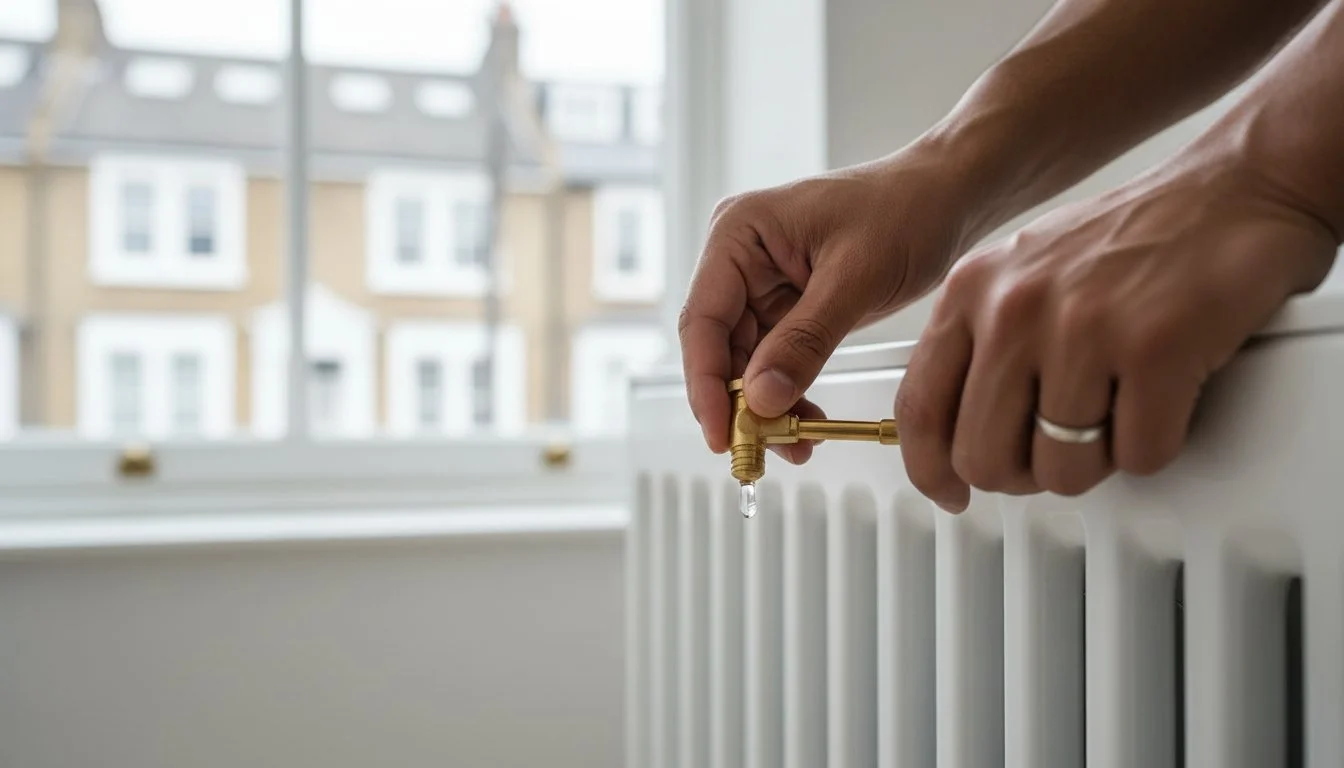
Locate the bleed valve, usually found at the top corner of the radiator. Place your towel and container directly underneath it. Insert the key and turn it slowly anti-clockwise. You will hear a distinct "hissing" sound as trapped gas escapes. Once water begins to trickle out, close the valve firmly. Pay close attention to the water color. Clear water indicates a healthy system, while dark, "inky" water suggests internal corrosion and the presence of magnetite sludge. Re-pressurising a standard UK combi boiler involves opening the filling loop valves until the pressure gauge reaches between 1.0 and 1.5 bar.
Radiator Balancing: The Pro Secret for London Flats
Many Londoners living in multi-storey Victorian conversions find that radiators furthest from the boiler stay cold, even after bleeding. This is a balancing issue. Hot water naturally takes the path of least resistance, often bypassing distant units. To fix cold spots on radiator London properties with multiple floors, you must adjust the lockshield valve. This is the valve covered by a plastic cap at the opposite end of the thermostatic valve. By slightly closing the lockshield on radiators closest to the boiler, you "push" hot water toward the colder rooms at the end of the line.
While these DIY steps solve most minor issues, you must know when to stop. If a valve is seized or won't budge with moderate pressure, do not force it. Snapping a valve head can lead to an immediate flood. Similarly, if your radiators remain cold after both bleeding and balancing, you likely have a severe air-lock or a blockage that requires professional intervention. At this stage, continuing to DIY risks damaging your central heating pump or causing a boiler lockout.
DownloadFeedback & RecreateDelete
When DIY Isn't Enough: Power Flushing and Professional Repairs
Simple bleeding often fails when the blockage is deep-seated sludge. A standard garden hose flush lacks the power to shift heavy magnetite from your system. Professionals use a high-velocity, low-pressure cleaning method known as power flushing. This process uses specialized chemicals to break down hardened deposits without damaging your pipes. It is the only way to fix cold spots on radiator London systems that have suffered years of hard water neglect.
Our expert engineers always finish a repair by adding a high-quality chemical inhibitor. This liquid creates a protective coating inside your radiators and pipes. It prevents the chemical reaction between London's hard water and your system's metal. Without this step, sludge will return within months, leading to more cold spots and wasted energy.
Signs You Need a Professional Power Flush
Engineers use a "Magnet Test" to diagnose your system. If a high-strength magnet sticks to the base of your radiator, it proves iron oxide sludge is present. You might also notice your boiler making a loud "kettling" noise, which sounds like a boiling kettle. This indicates that sludge is trapped in the heat exchanger. As of May 2026, a professional power flush for a standard 3-bedroom London home typically ranges from £388 to £913. While this is 15% to 25% higher than the national average, the service pays for itself within 2 to 4 years through reduced gas consumption and fewer emergency call-outs.
Repairing or Replacing Faulty Valves
Sometimes the radiator is fine, but the valve is broken. Thermostatic Radiator Valves (TRVs) often fail when the internal pin gets stuck in the closed position. This creates a "ghost" cold spot where the entire unit remains stone cold while the rest of the house is warm. Our team can replace these valves using the "bung" method, which allows us to swap the part without draining your entire system. This saves time and minimizes disruption to your home. If you have a seized valve that won't budge, you should find an emergency plumber in London for a same-day repair.
Ignoring these mechanical failures puts immense strain on your central heating pump. A struggling pump will eventually burn out, leading to a total loss of heating and hot water. If your touch test identified a cold middle or bottom section, you need technical intervention. You can book a guaranteed radiator repair today to restore your home's warmth and protect your boiler's lifespan.
Emergency Radiator Repairs in London: Why Speed Matters
A cold radiator in the middle of a London winter is more than a minor inconvenience. It's a precursor to a household crisis. When hot water stops circulating, the risk of frozen pipes increases significantly, especially in the exposed external walls of older Victorian properties. If you fail to fix cold spots on radiator London systems promptly, a localized blockage can escalate into a full system failure. This leads to burst pipes and extensive water damage that far exceeds the cost of a simple maintenance visit. Speed is the only way to protect your property and your wallet.
Our operation runs on a 24/7 dispatch model because heating emergencies don't stick to office hours. Every intervention is performed by a Gas Safe Engineer. This is the non-negotiable standard for any heating system work in the UK. Our professionals arrive with technical authority and the right tools to diagnose your issue immediately. We provide transparent, fixed-rate diagnostics to ensure you avoid the "London Premium" often charged by opportunistic contractors. You get an honest assessment and a definitive solution without the stress of hidden costs or surprise fees.
Our 24/7 Rapid Response Guarantee
We combine a "neighbor with a toolbox" approach with the efficiency of a professional emergency fleet. Our team covers the entire M25 corridor and Central London, often arriving at your door within 60 minutes of your call. Whether you're in a high-rise flat in Canary Wharf or a terraced house in Richmond, we have engineers stationed across North, South, East, and West London. We understand the urgency of a cold home during a cold snap. Our commitment to transparency means we provide clear pricing before any work begins. We maintain a strict policy of no hidden costs for all emergency call-outs; this ensures you have absolute peace of mind during a stressful situation.
Booking Your Radiator Specialist Today
Preparing for our visit helps us fix cold spots on radiator London systems even faster. Please ensure clear access to the affected radiators and identify your boiler's location before the engineer arrives. Having your boiler manual or service history ready can also speed up the diagnostic process. You're choosing a licensed, insured, and deeply experienced local team that takes pride in craftsmanship. We don't just patch the problem; we restore your system's integrity and efficiency. Don't let a cold spot turn into a winter catastrophe. Book your 24/7 emergency radiator repair now to secure your home's warmth and safety.
Restore Your Home's Warmth Today
Ignoring radiator cold spots is a gamble with your boiler's health and your energy bills. You now know how to distinguish between simple trapped air and the dangerous buildup of magnetite sludge. While a radiator key solves minor issues, complex blockages demand specialized equipment and chemical inhibitors to prevent a recurrence. You must fix cold spots on radiator London properties quickly to avoid the high cost of a total system lockout or burst pipes during a cold snap.
Our Gas Safe Registered Engineers provide the immediate response you need. We cover all of London and the M25 with a 24/7 dispatch model that prioritizes your safety. You'll benefit from transparent hourly rates and a strict policy of no hidden costs. We take pride in our work and the comfort of our local community. Need an expert to fix your cold radiators? Call our 24/7 London team now! Your home's warmth is our top priority and we are ready to restore your system's efficiency today.
Frequently Asked Questions
How much does it cost to fix a cold spot on a radiator in London?
A professional radiator repair in London typically costs between £80 and £250 depending on the cause of the blockage. With local labor rates for heating engineers averaging £90 per hour in 2026, simple valve repairs or balancing are relatively affordable. Addressing these issues early prevents the need for more expensive interventions like a full system power flush.
Can a cold radiator be a sign of a bigger boiler problem?
Yes, cold radiators often signal that your boiler is under extreme stress due to internal sludge or pump failure. When magnetite blockages occur, your central heating pump must work significantly harder to circulate water, which leads to premature wear. If left unaddressed, this strain can cause your heat exchanger to crack or lead to a total boiler lockout.
Is it worth repairing an old Victorian radiator or should I replace it?
Replacing an old radiator in London usually costs between £200 and £300, which is often more cost-effective than attempting to repair a heavily corroded Victorian unit. Modern radiators are designed for much higher thermal efficiency and help homeowners meet the 2026 carbon emission standards. If the internal channels are severely blocked by hardened sludge, a new installation provides better long-term value and reliability.
How often should I bleed my radiators in a London property?
You should bleed your radiators at least once a year, ideally during your autumn heating system check before the winter cold arrives. If you find yourself needing to release air more than twice a year, you likely have a slow leak or a corrosion issue. Regular bleeding ensures your system remains efficient and helps you identify potential problems before they become emergencies.
What happens if I ignore a cold spot on my radiator?
Ignoring a cold spot can increase your heating bills by up to 15% as your boiler runs longer to compensate for the lost heat output. Over time, the internal corrosion that causes these spots will eat through the metal, resulting in pinhole leaks and water damage to your property. It's much cheaper to fix cold spots on radiator London systems now than to pay for emergency leak detection and floor repairs later.
Do I need a Gas Safe engineer just to fix a cold radiator?
You don't need a Gas Safe engineer for simple tasks like bleeding a radiator, but you must use one for any work that involves system-wide repairs or boiler components. If your radiator requires a power flush or a valve replacement that involves the primary heating circuit, hiring a licensed professional is a non-negotiable safety standard. This ensures your system remains compliant with current UK building regulations and keeps your manufacturer's warranty valid.
Why is my radiator hot at the top but cold at the bottom after bleeding?
A radiator that is hot at the top but cold at the bottom is a classic sign of heavy magnetite sludge buildup. Bleeding only removes trapped gas from the top of the unit; it cannot shift the dense, metallic debris settled at the base. To fix cold spots on radiator London properties with this specific symptom, a professional power flush is required to clear the blockage and restore full circulation.
Can I perform a power flush myself at home?
You cannot perform a professional-grade power flush yourself because it requires specialized high-velocity, low-pressure machinery and industrial-strength chemicals. Standard DIY methods, like using a garden hose, are ineffective against stubborn London sludge and can introduce more air and debris into your boiler. Our experts use calibrated equipment to ensure every radiator is cleared safely without putting your pipes at risk of bursting.