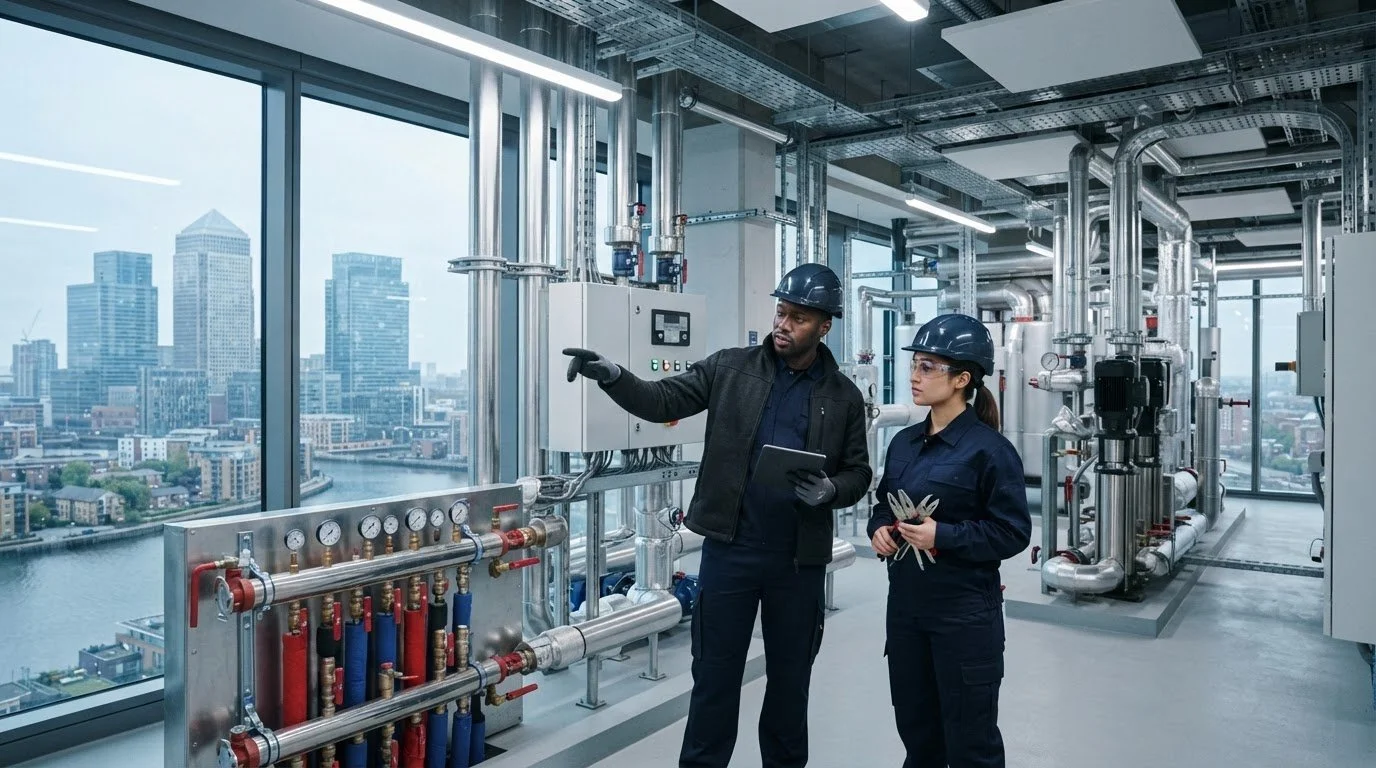
A burst riser pipe on the thirtieth floor of an E14 high-rise is not just a maintenance fault; it is an immediate operational crisis. When sourcing commercial plumbing Canary Wharf facilities managers cannot afford contractors who treat a corporate tower like a residential flat. High-density commercial estates demand specialized plant room competency, rapid loading bay clearance, and booster pump expertise from the moment an engineer arrives.
You already know that standard contractors fail when confronted with strict estate security, permits to work, and complex vertical drainage. Every minute spent stranded at a security barrier increases the risk of catastrophic water damage and expensive tenant downtime. Your building requires rapid, accredited commercial support that understands Docklands infrastructure inside out.
This 2026 facilities guide shows you how to procure reliable commercial plumbing services tailored to high-rise logistics, commercial heating plant rooms, and stringent water safety compliance. We break down the exact vetting criteria, response standards, and planned preventative maintenance protocols you need to protect your premises and maintain uninterrupted operations.
Key Takeaways
High-rise tower systems demand engineering teams trained in multi-stage booster pumps, hydrostatic pressure management, and complex vertical drainage.
Procuring accredited commercial plumbing Canary Wharf estates require means verifying commercial Gas Safe certifications and extensive liability coverage before engineers arrive on-site.
Navigating private Docklands security and loading bay logistics requires pre-cleared contractors capable of expediting strict permit-to-work protocols.
Rapid non-destructive leak detection and routine plant room boiler servicing protect high-density tenant assets from catastrophic water ingress.
Structured planned preventative maintenance contracts eliminate unexpected business downtime and deliver substantially better cost control than reactive emergency call-outs.
Table of Contents
Navigating Commercial Plumbing Challenges in Canary Wharf High-Rises
Essential Criteria for Selecting a Canary Wharf Commercial Plumbing Contractor
Core Commercial Plumbing Services Demanded by E14 Corporate Facilities
Compliance, Logistics, and Security Protocols in Canary Wharf Estates
Commercial Maintenance Contracts vs. Emergency Call-Outs: Making the Right Choice
Navigating Commercial Plumbing Challenges in Canary Wharf High-Rises
Maintaining vertical infrastructure in London's financial district requires far more than basic pipe repairs. In an office tower exceeding thirty storeys, commercial plumbing is an intricate network of pressurised risers, complex plant rooms, and balanced drainage systems. A single system imbalance can lead to massive structural disruption. In modern facility management, plumbing decisions directly protect multi-million-pound fit-outs and trading floor continuity.
When high-density office blocks suffer mechanical failures, the stakes are critical. An uncontrolled leak above a corporate server room or high-frequency trading floor causes immediate catastrophe. In commercial plumbing Canary Wharf estates present harsh operating conditions: high hydrostatic loads, continuous water usage, and thousands of workers sharing vertical sanitary stacks. Simultaneously, retail hubs like Jubilee Place demand durable tap and toilet repairs to handle footfall from tens of thousands of daily commuters without public outages.
High-Rise Hydraulic Pressure and Booster Set Vulnerabilities
Moving mains water hundreds of feet into the sky demands heavy-duty multi-stage booster pump systems. These pumps generate intense pressure. If pressure reducing valves (PRVs) fail or drift out of calibration on lower levels, downstream fixtures face extreme stress. This creates immediate risks:
Catastrophic joint ruptures: Excessive hydrostatic pressure blows out mechanical pipe joints, flooding office floors in minutes.
Severe water hammer: Rapid-closing sensor valves send destructive hydraulic shockwaves through aging copper risers, fracturing pipe brackets.
Premature seal failure: High baseline pressure shreds internal O-rings in commercial taps, creating hidden leaks behind drylining.
Vertical Soil Stacks and High-Density Drainage Demands
Drainage dynamics in Canary Wharf present equal complexity. Soil stacks in high-rise buildings manage substantial hydraulic drops, which generate severe air pressure variations. If stacks are unvented or neglected, positive pneumatic pressure blows foul sewer gas through water traps into executive suites.
At ground and sub-level concourses, high-volume restaurants discharge heavy grease loads. Without regular commercial drainage services and proactive grease management, grease rapidly solidifies within shared vertical drops. This backs up wastewater into lower-level office tenancies. Similarly, vacuum drainage systems common in Docklands complexes demand precise pressure tolerances. When specialized diagnostic equipment and planned maintenance are absent, small vacuum leaks shut down entire floor banks, halting tenant operations immediately.
Essential Criteria for Selecting a Canary Wharf Commercial Plumbing Contractor
Generic trade directories cannot filter for the rigorous demands of Docklands property management. Managing agents across E14 routinely mandate substantial public liability insurance thresholds, often up to £10 million, before approving contractor entry. Procuring commercial plumbing Canary Wharf facilities need requires a strict framework that screens for proven mechanical qualifications, corporate liability coverage, and established estate clearance protocols.
Mandatory Certifications and Regulatory Accreditations
Never permit an engineer into your central plant room without checking specific commercial credentials. Domestic tickets do not qualify an engineer to work on complex commercial infrastructure. Your contractor must hold:
Commercial Gas Safe registration: Essential for boilers and appliances exceeding seventy kilowatts net heat input.
Water hygiene certification: Full compliance with HSE ACoP L8 and HSG274 standards to manage Legionella risk, including monthly temperature logging and quarterly showerhead descaling.
WRAS compliance: Verified use of WRAS-approved valves and backflow prevention devices that satisfy UK building regulations for water systems and local water bylaws.
Response Speed and Service Level Agreement Guarantees
A burst riser pipe during business hours leaves no time for dispatch delays. Standard booking desks often route calls through external sub-contractors, losing valuable time. Facilities teams need clear service level agreements that guarantee dedicated dispatch rather than vague arrival estimates.
Your contract should define transparent escalation pathways for out-of-hours emergencies, ensuring direct access to seasoned mechanical engineers. Partnering with dedicated commercial plumbing specialists across London gives your estate 24/7 access to urgent repairs without middleman delays or unpredictable charges.
Assessing High-Rise Technical Diagnostics Capabilities
Locating a water ingress issue behind thirty floors of architectural panelling requires advanced technology, not guesswork. Reliable contractors deploy non-destructive leak detection tools, such as acoustic listening devices and high-resolution thermal imaging cameras. These tools pinpoint trace moisture without invasive demolition.
Likewise, drainage contractors must maintain commercial-grade CCTV push-rod cameras and jetting systems capable of inspecting vertical stacks across multiple floors. Engineers should demonstrate clear competency in isolating localized washroom banks, allowing urgent tap and toilet repairs to proceed without cutting off water supply to the entire building.
Core Commercial Plumbing Services Demanded by E14 Corporate Facilities
Canary Wharf towers function as self-contained micro-cities. Keeping these buildings operational requires mechanical, heating, and drainage capabilities that extend far beyond standard trade work. In commercial plumbing Canary Wharf contracts demand absolute precision across every square foot, from subterranean plant rooms to executive washrooms.
Specialized acoustic leak detection shields mission-critical trading floors and data suites by spotting micro-fissures before moisture escapes. Regular backflow prevention testing safeguards clean drinking water supplies against cross-contamination from cooling systems. At the same time, high-use corporate washrooms demand rapid tap and toilet repairs. As sensor-activated fittings continue to dominate modern commercial washrooms, facilities teams need prompt recalibration of touchless taps, solenoid valves, and automatic urinal flushing controls to prevent water waste and pressure drops.
Commercial Boiler Plant and Hot Water Calorifiers
Centralised heating in Docklands office blocks relies on multi-boiler cascade systems that balance immense heating loads. Certified engineers must run diagnostic checks on combustion efficiency, clean industrial heat exchangers, and verify flue gas integrity to ensure safe, continuous output.
Hot water calorifiers and unvented hot water cylinders supply thousands of occupants across vertical distribution loops. Maintaining secondary return pumps is vital to keep hot water circulating evenly. In accordance with HSE's ACOP L8 guidance, water must be stored at 60°C and reach outlets at 50°C or higher within one minute to eliminate Legionella risks across sprawling riser networks.
Preventative Drainage and Grease Trap Maintenance
Drainage failures in commercial properties instantly create health hazards and force tenant floor closures. Internal high-rise vertical stacks accumulate heavy mineral scale and uric encrustation, which narrows flow capacity over time. Specialized rotary mechanical descaling clears these internal linings without cracking fragile stack walls.
For corporate canteens and concourse dining venues, automated grease removal units require rigorous servicing to catch fats, oils, and grease before they reach shared stacks. Commercial drainage services must include planned, out-of-hours high-pressure water jetting. Conducting this work outside business hours clears lateral lines, prevents catastrophic backups, and protects ground-level tenant operations.
DownloadFeedback & RecreateDelete
Compliance, Logistics, and Security Protocols in Canary Wharf Estates
Executing commercial plumbing Canary Wharf projects requires an intimate understanding of private estate logistics. The Docklands financial district operates as a secure, managed environment. Mechanical contractors cannot simply park at the kerb and walk into a tower with a toolbox. Every engineering visit requires coordination through subterranean roadway networks, central security desks, and building management teams.
Plumbing failures do not wait for business hours, but managing agents cannot permit noisy plant work while financial markets are active. Disruption to trading floors is unacceptable. Facilities managers must rely on contractors who structure heavy interventions, such as high-pressure pipe clearing or mechanical plant overhauls, during scheduled evening and weekend windows.
Managing Estate Access and Loading Bay Clearances
Access to major commercial towers depends on getting into underground servicing docks. Estate marshals turn away unscheduled contractor vans without hesitation. Experienced commercial contractors coordinate these details well ahead of arrival:
Underground dock booking: Reserving dedicated loading bays through estate portals, matching vehicle dimensions to subterranean height restrictions.
Pre-cleared engineer credentials: Submitting verified digital identification to security control desks before the engineer arrives on-site.
Freight lift logistics: Arranging prioritized service elevator access to move diagnostic tools and replacement plant components directly to mechanical floors.
Permit-to-Work, Hot Works, and Risk Assessments
Before an engineer turns a single valve, building control requires complete safety documentation. Reliable commercial partners supply site-specific Risk Assessments and Method Statements (RAMS) that detail every mechanical step. This paperwork proves that all high-risk procedures are fully controlled.
Hot-work permits demand meticulous attention. When pipe alterations require brazing, soldering, or specialized pipe-freezing near occupied office spaces, engineers must enforce mandatory fire-watch protocols to protect building fire-alarm systems. Once work concludes, facilities teams need prompt digital records. Reputable contractors issue electronic Gas Safety Certificates and pressure testing sign-offs immediately, keeping your compliance registers up to date.
Need a mechanical partner experienced with Docklands security procedures? Book an accredited commercial plumbing engineer to resolve your plant room and pipework issues without access delays.
Commercial Maintenance Contracts vs. Emergency Call-Outs: Making the Right Choice
Relying exclusively on emergency call-outs is a high-risk gamble for corporate landlords. A single major pipe rupture can shutter an entire office floor, creating operational chaos across interconnected tenancies. When managing commercial plumbing Canary Wharf estates require a balanced strategy that pairs immediate round-the-clock emergency readiness with structured preventative care. Unplanned downtime damages tenant trust and triggers substantial remediation costs.
Reactive Emergency Repairs: When Every Minute Counts
When an unpredicted pipe burst strikes an overhead supply line, response speed determines the scale of property loss. Minutes matter. Unchecked water quickly penetrates raised-access flooring, compromising data cabling and threatening electrical risers below. Direct 24/7 engineer dispatch ensures rapid water containment before escaped volume damages neighbouring corporate tenancies or forces long-term tenant relocation.
Planned Preventative Maintenance: Ensuring Long-Term Reliability
Planned preventative maintenance (PPM) stops mechanical failures before they interrupt trading hours. Routine servicing preserves expensive central plant assets and extends the working lifespan of multi-stage booster pumps, commercial calorifiers, and heating boilers. A structured PPM schedule provides continuous protection:
Thermal and acoustic diagnostics: Spotting hidden riser stress and hairline fractures before water breaches partition walls.
Booster set servicing: Checking mechanical seals, testing expansion vessels, and replacing worn pump bearings to prevent total pressure loss.
Valve exercising and descaling: Testing pressure reducing valves and cleaning hot water cylinder feeds to ensure smooth hydraulic balance across all levels.
Partnering with 24hr Plumbing and Heating
Protecting high-density corporate towers requires an engineering partner with genuine Docklands logistical familiarity. 24hr Plumbing and Heating delivers the dedicated commercial plumbing Canary Wharf organizations depend on to protect corporate business continuity. Our certified Gas Safe engineers provide rapid emergency response alongside tailored commercial maintenance contracts for London business premises. From critical leak detection and central boiler servicing to planned drainage clearing, we keep your commercial facilities fully compliant and operational around the clock.
Protect Your Facility with Proven Canary Wharf Mechanical Experts
Operating a high-rise office tower leaves zero margin for mechanical error. Sourcing the right commercial plumbing Canary Wharf estates demand means choosing engineers who master multi-stage booster sets, strict permit-to-work protocols, and rapid underground loading bay logistics. Planned preventative maintenance protects your commercial plant assets, while immediate non-destructive diagnostics keep tenant operations running without interruption.
Our 24/7 rapid response engineering team covers London commercial districts day and night. With fully certified Gas Safe commercial engineers and tailored commercial maintenance contracts, 24hr Plumbing and Heating safeguards corporate business continuity across every floor.
Take control of your facility's operational resilience now. Secure reliable commercial plumbing and 24/7 rapid response for your business to protect your tenants and maintain total compliance.
Frequently Asked Questions
What qualifies a contractor to deliver commercial plumbing in Canary Wharf office buildings?
A qualified contractor must hold commercial Gas Safe registration, minimum £10 million public liability insurance, and proven experience in high-rise mechanical plant rooms. Engineers need direct familiarity with subterranean loading bay bookings, multi-stage booster pump systems, and estate security protocols. Domestic accreditations alone do not qualify a contractor to manage corporate risers or commercial central heating installations.
How fast can commercial emergency plumbers arrive at an E14 business premises?
Dedicated commercial dispatch services deploy mobile engineers across London with direct routes into E14, aiming for rapid on-site arrival. Response times depend on pre-arranged estate access passes and loading bay clearances. When facilities teams establish planned maintenance contracts, contractors maintain pre-approved security credentials, eliminating gatehouse check-in delays during active pipe ruptures.
Can commercial plumbing repairs be performed outside regular trading and office hours?
Yes, out-of-hours scheduling is standard practice for high-density corporate estates. Experienced providers of commercial plumbing Canary Wharf businesses depend on operate 24/7. This allows noisy mechanical tasks, high-pressure drainage jetting, and water main isolations to take place overnight or across weekends, preventing disruption to active trading desks and ground-floor retail footfall.
What certifications are required for servicing high-capacity commercial gas boilers?
Engineers must hold certified commercial Gas Safe qualifications, specifically covering appliances and cascade systems with inputs exceeding seventy kilowatts. In addition to boiler servicing credentials, technicians need combustion analysis competency, commercial flue flow testing certification, and the authority to issue official CP12 Gas Safety Certificates upon completing plant room inspections.
How does high water pressure in tall towers affect commercial plumbing fittings?
Extreme hydrostatic pressure in tall buildings accelerates mechanical wear on seals, valves, and pipe joints on lower levels. If pressure reducing valves drift out of alignment, the resulting force causes water hammer, blows out sensor-tap solenoid valves, and ruptures copper joins. Regular recalibration and balanced expansion vessels are vital to stabilize internal hydraulic forces.
What documentation is required to clear hot-works plumbing permits in Canary Wharf estates?
Managing agents require site-specific Risk Assessments and Method Statements (RAMS), valid engineer insurance certificates, and proof of mechanical competency. For soldering, brazing, or pipe-freezing, contractors must secure a signed hot-work permit from building security. This permit specifies precise work windows, continuous fire-watch supervision, and post-work thermal scans before departing.
Why is acoustic leak detection necessary for corporate commercial properties?
Acoustic leak detection pinpoints pressurized water escapes behind solid walls and raised floors without destructive demolition. High-frequency listening sensors isolate the sound of weeping pipe joints beneath server suites and trading floors. Locating hidden leaks early prevents structural water damage, stops mold development, and averts catastrophic data infrastructure downtime.