What if that faint, earthy scent in your garden isn't mulch, but the first warning of a catastrophic sewage backup? For many London homeowners, the distinction between a minor sink clog and a major external failure remains a mystery until the garden is underwater. Identifying the signs of a blocked drain outside early is the only way to prevent internal flooding and avoid the stress of a midnight emergency. You likely feel the pressure of maintaining a property in a city where Victorian infrastructure often clashes with modern living. It's a common fear, especially when you're unsure if the repair bill belongs to you or Thames Water.
We'll provide the definitive confirmation you need to take action today. This guide outlines the specific red flags that signal a main line blockage, from rising gully levels to foul smells near your property boundary. You'll learn the 2026 regulations regarding shared sewers and how to stop a minor blockage from becoming a costly property disaster. We're here to give you the technical clarity required to protect your home and your wallet through expert diagnostics and rapid response.
Key Takeaways
Learn to identify the early signs of a blocked drain outside, including foul "rotten egg" odours and unusual gurgling sounds from your external pipework.
Master a quick visual inspection of your gullies and manholes to spot rising water levels before they cause garden flooding or structural damp.
Understand how London's unique Victorian infrastructure and shifting clay soil conditions contribute to frequent pipe collapses and blockages.
Clarify your legal responsibilities so you know exactly when to call a private professional and when the issue belongs to the water company.
Discover how modern tools like high-pressure water jetting and CCTV surveys provide immediate, definitive solutions for external drainage failures.
Table of Contents
Performing a Visual Inspection: Gullies, Manholes, and Pooling
Professional Solutions: How 24hr Plumbing Clears Outside Blocks
The Sensory Warning Signs: Smell, Sound, and Slow Drains
Detecting the signs of a blocked drain outside usually starts with your senses before you ever see a drop of standing water. Modern Drainage systems are designed to keep waste and gases contained, so any breach creates an immediate sensory footprint. Recognising the signs of a blocked drain outside early saves thousands in repair bills and prevents the nightmare of internal sewage flooding.
Identifying the Source of Foul Odours
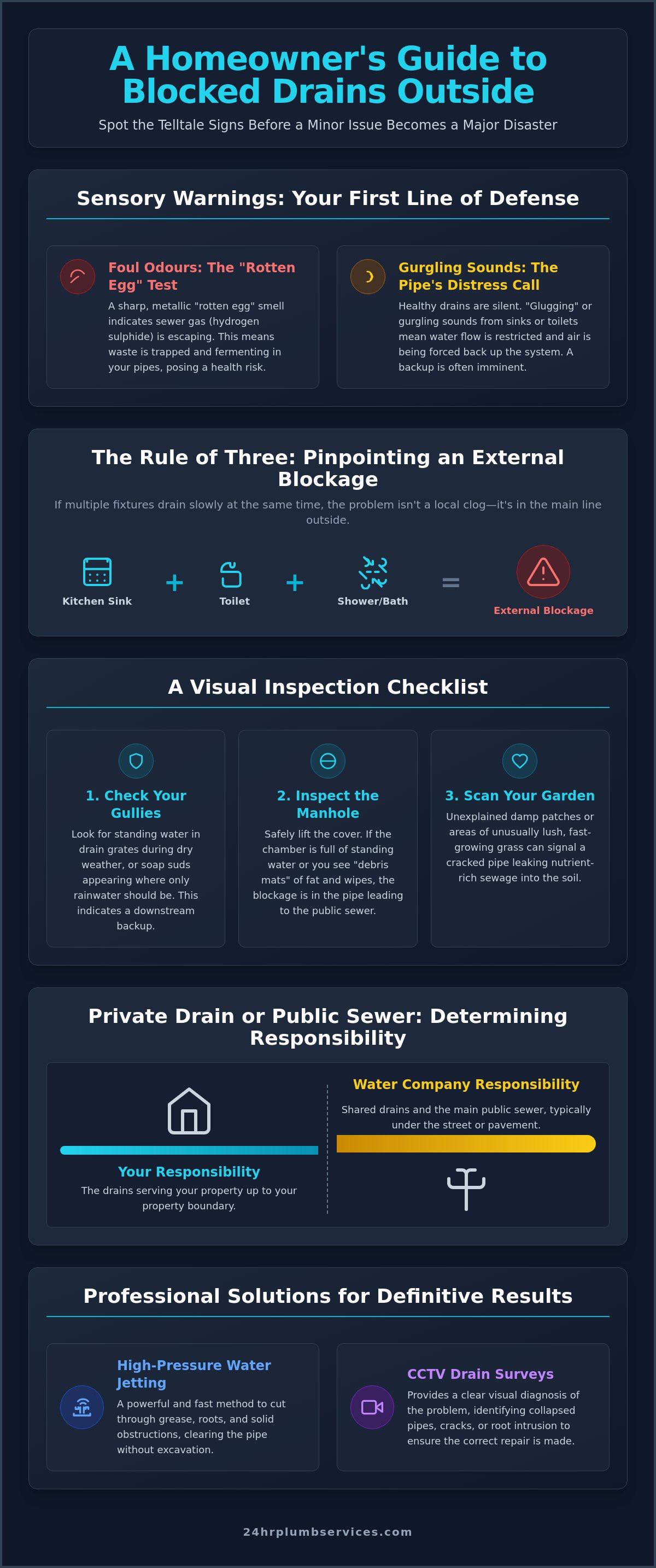
The "Rotten Egg" test is a definitive way to gauge the severity of a blockage. This scent comes from sewer gas, which is primarily composed of hydrogen sulphide. While decomposing leaves in a gully might smell earthy or damp, a sewer block smells sharp and metallic. In London, fluctuations in atmospheric pressure often push these gases out of external vents or cracked pipes before they penetrate your home. Don't ignore these odours during humid summer months. Sewage gas is toxic and indicates that waste is trapped and fermenting just feet from your back door.
The Gurgling Pipe: A Warning of Trapped Air
Audible warnings are equally telling. When an external pipe is restricted, water has to fight past the obstruction, displacing air back up through the system. This creates a distinct "glugging" or "gurgling" sound. You might hear it in your kitchen sink when the washing machine drains, or in the toilet after a heavy rainstorm. A healthy drain is silent. If your pipes are talking to you, it's because the flow is restricted. This isn't just an annoyance; it's a mechanical warning that a total backup is imminent.
The rule of three is your best diagnostic tool. If a single bathroom sink drains slowly, you likely have a local hair clog. However, if your toilet, shower, and kitchen sink all struggle simultaneously, the problem is downstream. Multiple slow fixtures are a guaranteed indicator of an external blockage. This requires immediate professional intervention to prevent sewage from backing up into your ground floor or basement.
Waiting for the problem to clear itself is a dangerous strategy. Raw sewage contains pathogens and bacteria that pose significant health risks to your family and pets. External leaks can contaminate your garden soil or seep into your property's foundations, leading to structural damp and expensive remediation costs. We treat these sensory warnings as household crises because they precede the flooding that ruins carpets and floorboards. If you smell it or hear it, the blockage is already established.
Performing a Visual Inspection: Gullies, Manholes, and Pooling
Visual evidence provides the definitive proof you need before calling in professional help. While sensory cues are reliable, a physical inspection confirms exactly where the system has failed. You don't need heavy machinery to spot the primary signs of a blocked drain outside. You just need to know where to look. Start at the perimeter of your home and work your way toward the property boundary.
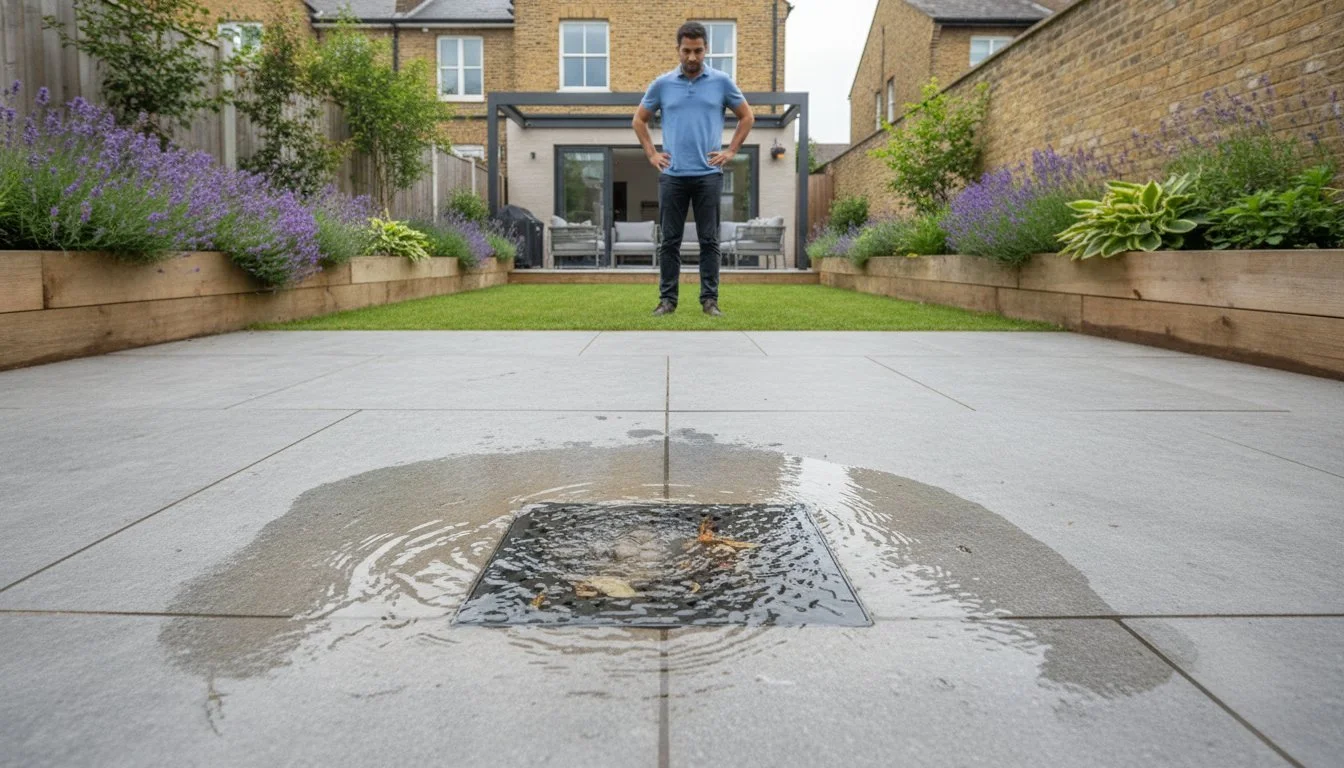
Begin by checking your external gullies. These are the open drain grates where your rainwater downpipes and kitchen waste pipes meet the ground. If you see water sitting high in the grate during dry weather, the trap is blocked. Next, scan your garden or driveway for unexplained damp patches. In London's competitive gardening circles, a patch of "lush," fast-growing grass might seem like a win. In reality, it often signals a cracked pipe leaking nutrient-rich sewage into the soil. This ground saturation can eventually undermine your foundations.
The most critical step is inspecting the manhole, also known as the inspection chamber. Use a manhole key or a sturdy screwdriver to lift the cover safely. If the chamber is filled with standing water, the blockage is downstream, likely heading toward the public sewer. If you see "debris mats"-thick layers of congealed fat, oil, and wet wipes-the system is already failing. If you discover standing water in your chamber, our team provides rapid-response drainage services to prevent a total sewage backup.
The Gully Check: Leaves vs. Sewage
Distinguishing between surface debris and a deep-seated block is vital. A gully covered in autumn leaves is a simple maintenance task. However, if soap suds from your washing machine appear in a garden gully that should only handle rainwater, you have a cross-connection or a downstream backup. Standing water that remains static for more than 24 hours after a London downpour is a clear indicator that the exit pipe is compromised. If the blockage appears to be in the street or shared sewer, you may need to Report a blocked public drain to your local authority or water provider.
Inside the Inspection Chamber
Safety is your first priority. Never climb into a manhole; toxic sewer gases can overcome a person in seconds. From the surface, look for the "benching"-the concrete sloped sides at the bottom of the chamber. In a healthy system, the benching is dry and the central channel is clear. Perform a "paper test" by having someone flush a toilet inside. If the water and paper don't flow freely through the chamber, or if they sit stagnant in the channel, your external drainage has officially failed.
The London Factor: Why Our Drains Block Differently
London's drainage infrastructure is a unique beast. Unlike newer developments in other parts of the UK, most London properties rely on a "Victorian stack" or aged clay pipework. These systems weren't built for the volume of fat, oil, and wet wipes modern households produce. When you investigate the signs of a blocked drain outside, you're often seeing the result of decades of wear meeting unforgiving geological conditions. We see these failures daily across the capital, where 150-year-old pipes finally reach their breaking point.
The city sits on a massive layer of London Clay. This soil is notorious for shifting, expanding when wet and shrinking during dry spells. This constant movement physically displaces your external pipes. It creates "bellies" or dips where water pools instead of flowing. These stagnant sections become magnets for debris. Over time, the heavy clay soil can even crush older pipes that have been weakened by age or previous minor leaks.
London is also a notorious hard water area. This means mineral deposits are constantly forming inside your lines. Limescale build-up reduces the diameter of external pipes over decades, creating a rough surface that catches grease and hair. It acts like a biological glue. It turns a minor clog into a solid mass that traditional rodding alone cannot clear. This is why London drains require a more aggressive, technical approach than pipes in soft water regions.
Victorian Clay Pipes vs. Modern PVC
Clay pipes are the backbone of London's older boroughs. While durable, they feature joints every few feet. These joints were often sealed with cement that has since crumbled or washed away. Modern PVC is a single, smooth run. In contrast, your Victorian clay pipes are textured and prone to catching "fatbergs." If your home was built before 1920, your pipes are likely clay. This makes them significantly more vulnerable to structural collapse and joint failure than modern plastic alternatives.
Tree Roots: The Silent Drain Killers
In leafy suburbs like Richmond, Hampstead, or Dulwich, tree roots are the primary cause of external drainage failure. Roots are biologically programmed to find moisture. They sense the microscopic leaks in old clay joints and force their way inside. Once a single hair-like root enters, it grows into a massive "tap root" that fills the pipe's diameter. You'll know a block is structural rather than just a clog if the water levels in your manhole don't drop after rodding. This indicates the pipe is physically obstructed or crushed by the root system.
DownloadFeedback & RecreateDelete
Private Drain or Public Sewer? Determining Responsibility
Determining who pays for a repair is often the most stressful part of a drainage crisis. Since the major law change on 1 October 2011, the responsibility for many external pipes shifted from the homeowner to the statutory water company. In London, this is usually Thames Water. Despite this transfer, you remain legally responsible for the "private drain." This is the section of pipework located within your property boundary that serves only your home. If the pipe serves more than one property, it is classified as a public sewer regardless of where it sits on the land.
If you identify the signs of a blocked drain outside, check the location of the issue immediately. If the blockage occurs in a "lateral drain," which is the part of your drain that lies outside your property boundary, or in a sewer that serves multiple properties, it's a public matter. However, if the backup is limited to your own gully or the section of pipe before it joins a neighbour's line, the responsibility for unblocking rests with you. Understanding this boundary saves you from unnecessary call-out fees and ensures the right people are on-site to fix the problem.
The Shared Stack Problem in London Terraces
London's Victorian terrace streets present a unique challenge for determining responsibility. These properties often feature a "shared stack" or a communal drain run that gathers waste from several houses before reaching the main sewer in the road. If you and your neighbours all notice slow drains or foul smells at the same time, the blockage is almost certainly in a shared section. In this scenario, you should contact Thames Water first. They are responsible for maintaining shared sewers, even those located on private land. We recommend a quick chat with your neighbours. It's the fastest way to confirm if the problem is isolated to your property or a wider community issue.
When to Call a Professional Emergency Plumber
You should call for Emergency Drain Unblocking London if the blockage is clearly within your private boundary. Waiting for a water company to investigate a private issue can take days. They will often refuse the work if the fault isn't theirs, leaving you back at square one. If sewage is currently threatening to enter your home or garden, you cannot afford the delay. A professional rapid-response team can diagnose the block and clear it within hours, preventing permanent structural damage. For immediate assistance with urgent sewage overflows, our team provides expert drainage services across the M25. We provide the technical authority and speed required to protect your home from a total system failure.
Professional Solutions: How 24hr Plumbing Clears Outside Blocks
Once you identify the signs of a blocked drain outside, you need a resolution that is both permanent and immediate. At 24hr Plumbing and Heating, we don't just "poke holes" in blockages; we restore your drainage system to its full capacity. Our team uses industrial-grade technology to tackle the specific challenges of London's infrastructure. Whether you are dealing with a congealed fatberg or a structural failure, our 24/7 rapid response ensures that your property remains safe and dry. We treat every external block as a potential emergency because the risk of sewage backing up into your home is too high to ignore.
High-Pressure Jetting vs. Manual Rodding
Many homeowners reach for traditional drain rods first. While rods can clear a soft clog, they often fail against the hardened scale and fat common in London pipes. High-Pressure Water Jetting (HPWJ) is the industry standard for a reason. It uses concentrated streams of water to "scrub" the internal walls of the pipe clean. This process is highly effective for removing invasive tree roots and mineral build-up that rods simply cannot touch. We take precise care to protect your property from "blowback" by managing pressure levels and using specialised nozzles designed for Victorian clay pipes. This ensures a thorough clean without risking the integrity of your drainage system.
CCTV Surveys: The 'No-Dig' Diagnostic
The days of digging up your garden to find a leak are over. We use waterproof, high-definition cameras to navigate your external pipework and identify the exact cause of the failure. This "no-dig" technology allows us to see roots, cracks, or total collapses in real-time. It provides a definitive diagnostic that prevents unnecessary excavation and saves you money. If you suspect a structural issue or a recurring block, you can Book an Emergency Drain Inspection Now to get a clear view of the problem. We provide you with the HD footage and a professional report so you have absolute technical clarity on the state of your drains.
For smaller external gullies where jetting hoses might be too large, we employ electro-mechanical cleaning. This uses flexible steel cables to physically break down tough obstructions like congealed grease or food waste. We provide these comprehensive drainage services around the clock across London and the M25. External blocks don't wait for business hours, and neither do we. Our engineers arrive with the technical authority and equipment needed to resolve your crisis on the first visit, backed by transparent pricing and a commitment to London's homeowners.
Protect Your London Home from External Drainage Failure
Ignoring the initial signs of a blocked drain outside is a risk no London homeowner should take. You now have the tools to distinguish between a simple gully clog and a major main line failure. You understand the legal boundaries between your private pipes and the public sewers managed by Thames Water. Early identification is the only way to prevent toxic sewage from saturating your garden or entering your property foundations. Professional intervention ensures these issues are resolved before they become structural disasters.
Our team provides absolute technical authority and immediate relief when a crisis strikes. We specialise in high-pressure water jetting and HD CCTV surveys to clear stubborn blockages without the need for destructive digging. We offer fixed-price diagnostics to ensure total transparency. With a 24/7 rapid response across London and the M25, we are always available to secure your home. Facing a drainage emergency? Call our 24/7 London team now! You can rest easy knowing your property is in the hands of seasoned professionals who value craftsmanship and efficiency.
Frequently Asked Questions
Is a blocked outside drain an emergency?
Yes, a blocked outside drain is an emergency if sewage is overflowing or if waste water is backing up into your ground floor. Stagnant waste poses immediate health risks and can cause permanent structural damage to your property's foundations. If you notice these signs of a blocked drain outside, you should seek professional help immediately to prevent internal flooding and costly remediation.
Who is responsible for a blocked drain outside my house in London?
You are responsible for the drains within your property boundary that serve only your home. Thames Water takes responsibility for public sewers and any pipes shared with neighbours, even if they are located on your private land. This division was formalised in 2011 to simplify maintenance across London's complex terrace layouts and older infrastructure.
Can I use a chemical drain unblocker on an outside drain?
You should avoid using chemical unblockers on external drains. They are rarely effective against large-scale obstructions like fatbergs, silt, or tree roots. These chemicals are highly corrosive and can damage older Victorian clay pipes. They also pose a significant risk to the local environment and the London water table when used in outdoor gullies.
Will heavy rain clear a blocked outside drain?
Heavy rain will not clear a blockage; it usually triggers a complete system failure. Increased water volume puts immense pressure on the restriction, causing gullies to overflow and manholes to lift. Rainwater often carries extra silt and debris into the system. This compacts existing clogs and makes them significantly harder to remove without professional equipment.
How much does it cost to unblock an outside drain in London?
The average cost for residential drain unblocking in London typically ranges from £90 to £180 for standard issues. More complex blockages requiring high-pressure jetting can cost between £150 and £250. These rates reflect the higher operating costs, specialized equipment, and traffic congestion inherent to providing rapid response services within the M25 area.
What are the signs of a collapsed drain outside?
Signs of a collapsed drain include persistent blockages that return shortly after clearing and visible subsidence in your driveway or garden. You might also see cracks appearing in external brickwork or patches of unusually lush grass growth. A CCTV survey is the only definitive way to confirm a collapse and assess the structural integrity of the pipe without excavation.
Can tree roots be removed from a drain without digging it up?
Yes, tree roots can be removed without digging through high-pressure water jetting or specialist mechanical cutters. These tools strip the roots from the internal pipe walls and flush them through the system. Once the flow is restored, we often recommend a structural liner to seal the entry points and prevent the roots from returning to the moisture source.
Why does my garden smell like sewage but the drains are running fine?
A sewage smell in the garden often indicates a cracked pipe or a faulty vent stack, even if the water is currently flowing. This occurs when sewer gas escapes through small fissures or dry gullies. It is often one of the earliest signs of a blocked drain outside or a failing joint that requires a professional pressure test to locate before the pipe fails completely.